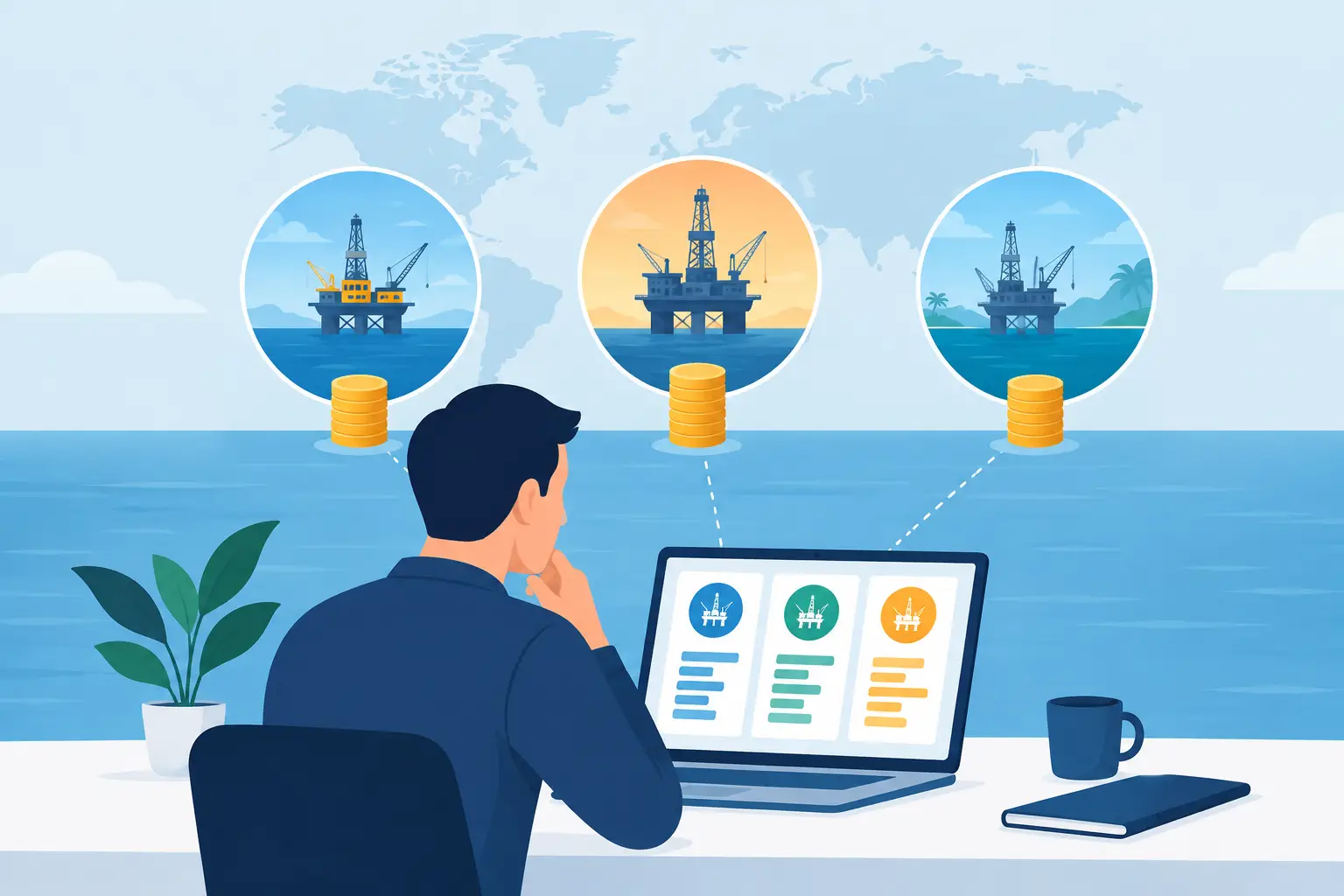
A strong offshore pay comparison starts with one hard truth: there is no single offshore salary. Two people can work on the same vessel or platform, fly the same rotation, and still take home very different amounts because their role, credentials, contract type, and tax position are different.
That is good news for career changers. Offshore pay is not reserved for people who began in oil and gas at 18. It rewards useful skills, safety readiness, reliability, and the ability to work in demanding conditions. The goal is not to chase the biggest number in a job ad. The goal is to understand what drives offshore earnings, identify the highest-value route you can realistically enter, and build the qualifications employers will pay for.
Why Offshore Pay Is Different From a Normal Salary
Most land-based jobs are paid as a weekly, hourly, or annual salary. Offshore compensation can be structured around day rates, fixed monthly pay, rotation pay, overtime, project bonuses, travel allowances, retention bonuses, or a combination of several items. A job that looks lower on paper may be financially stronger when paid travel, meals, accommodation, and a long block of time off are included.
Rotations matter just as much as the rate. A common schedule might be 14 days on and 14 days off, 21 days on and 21 days off, or 28 days on and 28 days off. Some employers pay only while you are on board. Others pay a regular salary across the full rotation. Never assume your off days are paid until you see the offer and contract terms.
For US-based workers, tax treatment also changes the real value of an offshore package. For international workers, residency rules, payroll country, and local tax obligations can make an apparently higher rate less valuable than a lower, cleaner package. A pay figure without its contract terms is not a comparison. It is just a headline.
Offshore Pay Comparison by Role Level
The broad pattern is straightforward: entry and support roles usually pay less than skilled technical, operational, and supervisory positions. But entry roles can still create a major income jump for someone moving from unstable hourly work, especially when food, lodging, and travel are covered during the hitch.
Entry-Level and Support Roles
Entry routes can include roustabout, deck crew, utility worker, galley support, catering, cleaning, logistics support, and certain trainee positions. Availability depends heavily on the region and employer. These jobs often involve physically demanding work, cleaning, lifting, cargo handling, basic maintenance support, and strict compliance with instructions.
Pay at this level is usually the starting point, not the finish line. Employers are paying for your dependability, medical fitness, ability to live in a close crew environment, and willingness to follow safety systems. Candidates with construction, warehousing, maritime, mechanical, or industrial-site experience may have a stronger case than they realize because they already understand shift work, equipment hazards, and worksite discipline.
The advantage is access. The trade-off is that competition can be high, schedules may be less predictable, and some roles are contract-based rather than permanent. A newcomer should focus on getting a credible first assignment while building the record and certifications needed for better-paid work.
Skilled Trades and Technical Crew
Mechanical technicians, electricians, welders, riggers, crane operators, instrument technicians, hydraulic specialists, marine crew, and similar trades generally command higher pay because they solve problems that can stop operations or create serious risk.
This is where previous hands-on experience can move you ahead quickly. A qualified electrician with documented industrial experience is not competing in the same pay bracket as a first-time general labor candidate. The same applies to experienced mechanics, welders, and lifting professionals.
Higher pay comes with higher standards. Employers may require trade licenses, documented sea time or offshore experience, equipment-specific competence, client approvals, drug and alcohol screening, and a stronger safety record. A certification alone does not turn a beginner into a senior technician. It does, however, help prove that you understand the environment and are ready to be considered.
Drilling, Production, Marine, and Specialist Roles
Drilling crews, production operators, subsea teams, dynamic positioning personnel, offshore medics, ROV technicians, survey teams, and specialist maintenance professionals can earn substantially more than entry-level crew. These roles often carry direct responsibility for production, well operations, vessel position, critical equipment, or emergency response.
The barrier to entry is higher because the cost of getting it wrong is high. These positions commonly require experience, recognized technical training, role-specific certificates, and a proven record in safety-critical work. They are excellent long-term targets, but they should be approached as a career plan rather than a quick first application.
Supervisors and Senior Specialists
Supervisors, offshore installation managers, senior engineers, captains, drilling supervisors, and niche specialists often sit at the top of the pay scale. Their compensation reflects years of technical capability, leadership under pressure, regulatory responsibility, and decision-making authority.
The lesson is not that every new candidate needs to aim for management. It is that offshore work can have a visible earnings ladder. Your first role is one rung. The next certifications, projects, and responsibilities determine how quickly you climb.
The Factors That Change What You Take Home
A useful offshore pay comparison looks beyond job title. Start with the rotation. A high day rate for 14 paid days per month may not beat a slightly lower annualized salary that pays during your full time off. Ask whether travel days are paid, whether mobilization and demobilization are compensated, and whether weather delays or project shutdowns affect your income.
Then look at location. Deepwater operations, remote international projects, harsh-weather regions, and difficult logistics can increase pay, but they may also mean longer travel, more demanding conditions, or less stable contract work. The Gulf of Mexico, North Sea, West Africa, Middle East, Brazil, and offshore wind markets all operate differently. Credentials that open doors in one market may not be enough in another.
Employer type matters too. Major operators, drilling contractors, vessel owners, service companies, catering providers, and labor agencies do not always offer the same package for similar work. A contractor may provide a higher rate but fewer benefits. A permanent role may offer a lower headline figure with steadier assignments, training support, insurance, and a clearer promotion path.
Finally, consider your actual expense picture. If you currently spend heavily on commuting, meals, rent near a job site, or unpaid gaps between shifts, offshore work can improve your financial position even before a large rate increase. But do not build your budget around a rotation until you understand whether the employer guarantees work and how often contracts are renewed.
How to Compare Two Offshore Job Offers
When you receive an offer, put both roles into the same frame: expected gross annual earnings, paid days, unpaid days, travel requirements, benefits, taxes, and likely time between assignments. This prevents a flashy day rate from hiding a short project or an unpaid standby period.
Ask the recruiter or employer direct questions. Is the quoted amount a day rate, monthly salary, or annual salary? Is it paid on travel days and days off? What rotation applies? Is the role permanent, fixed-term, or call-out? Who covers flights, accommodation, medicals, training, and renewals? Are overtime, night work, and hazard premiums included or separate?
A professional employer should expect these questions. You are not being difficult. You are making a career decision with real financial consequences.
Increase Your Value Before You Apply
The fastest way to improve your offshore earning potential is not sending 200 generic applications. It is becoming easier to hire. That means an offshore-ready CV, accurate work history, relevant safety training, required medical clearance, and applications targeted to employers that actually hire your level of experience.
Do not spend money on random certificates because a social media post says they are required. Training requirements vary by role and region. Start with the jobs you can realistically pursue, then identify the credentials those employers consistently request. For many candidates, basic offshore safety training, survival training, medical fitness, and role-specific technical proof form the foundation. The exact path depends on whether you are targeting drilling, marine work, offshore wind, support services, or a trade role.
Your CV should show more than job titles. Make it clear that you can follow procedures, work shifts, use tools, complete inspections, support maintenance, communicate with a crew, and operate safely around lifting, machinery, or hazardous energy. Those details help employers see an offshore-ready worker instead of an applicant with unrelated experience.
Build a Pay Plan, Not a Pay Fantasy
Offshore work can create a meaningful income change, especially for people ready to work rotational schedules and develop technical value. It can also involve missed family events, long travel days, medical requirements, strict behavior standards, and periods between contracts. The best-paying route is not always the best first move.
Choose the entry point that matches your current skills, then build toward the role that matches your income goal. RouteK’s approach is built around that practical sequence: understand the market, prepare to employer standards, apply with purpose, and keep adding value after your first offshore assignment. The right offshore career is not found by guessing at salary posts. It is built through the qualifications and work record that make better offers possible.
Leave a Reply