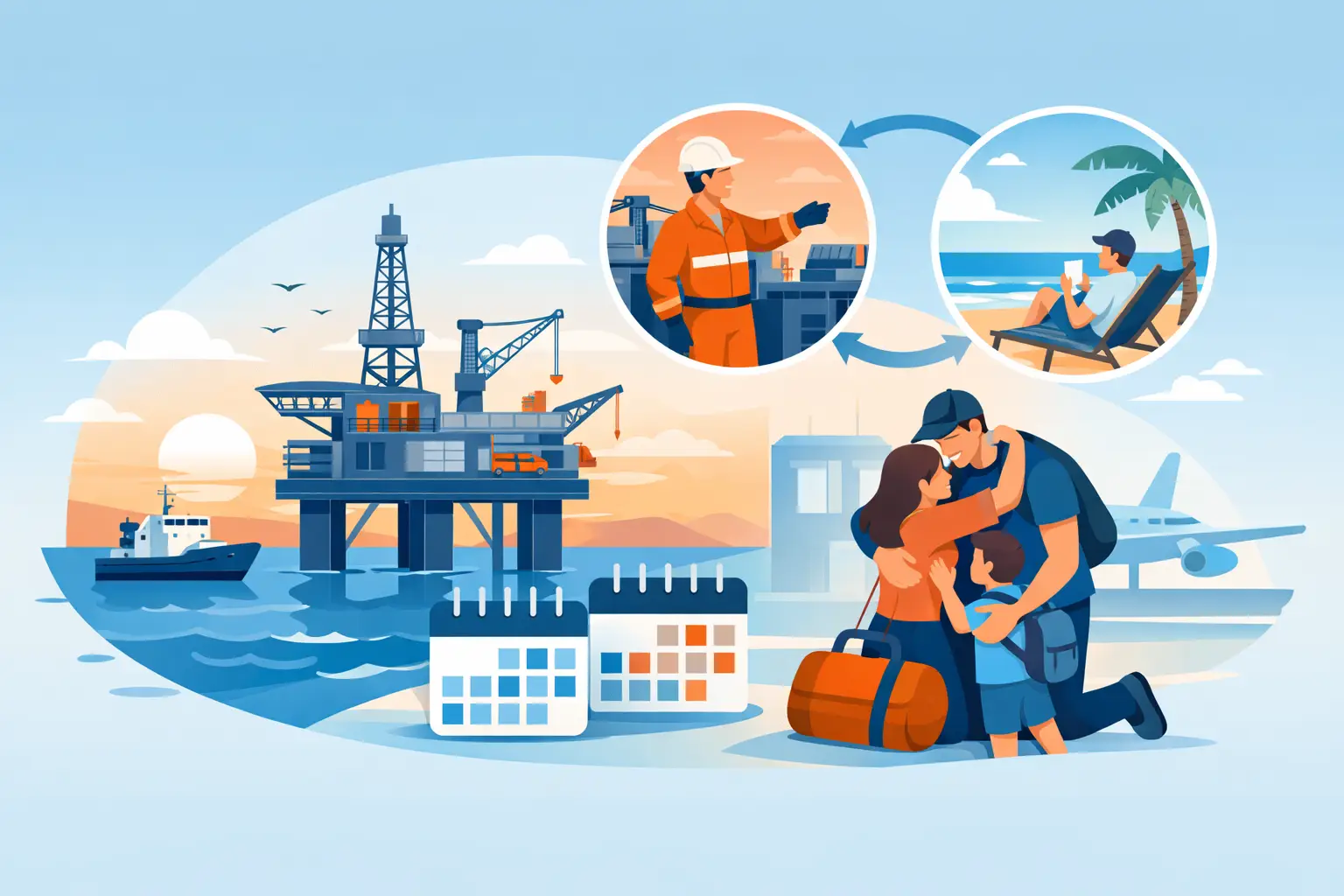
An offshore rotational work schedule can change far more than your paycheck. It changes how you plan family time, manage travel, prepare for demanding shifts, and think about a career. For many people coming from construction, trucking, industrial work, or other hands-on roles, the appeal is clear: work hard for a set period, then have a real block of time at home.
But rotation is not the same as a vacation schedule. Offshore employers expect you to arrive fit for duty, prepared, certified, and ready to work long days in a safety-critical environment. Understanding how rotations actually work helps you decide whether offshore is the right move and helps you present yourself as a candidate who understands the job.
How an Offshore Rotational Work Schedule Works
A rotation is a planned cycle of time worked offshore followed by time off onshore. You may hear it described as “weeks on, weeks off,” but the exact pattern depends on the country, employer, vessel or facility type, contract, role, and project needs.
Common examples include 14 days on and 14 days off, 14 days on and 21 days off, 21 days on and 21 days off, or 28 days on and 28 days off. Some international assignments run longer, particularly when travel distances are significant or crews are working in remote locations. In the Gulf of Mexico, two-week hitches are common in many roles, although schedules are never guaranteed across every employer.
During your hitch, you typically live at the worksite. That could be an offshore oil platform, drilling rig, production facility, wind farm installation vessel, support vessel, or another marine operation. Accommodation, meals, and basic living facilities are generally provided because workers cannot simply leave at the end of the day.
Your crew change date matters. On the day you travel out, you may take a helicopter, crew boat, or vessel to the worksite. Weather, logistics, mechanical issues, and operational demands can delay that trip. Likewise, a planned return date can move. A good offshore worker plans for the schedule while recognizing that operations come first.
Long shifts are standard
Most offshore roles operate on 12-hour shifts. You may work days, such as 6 a.m. to 6 p.m., or nights, such as 6 p.m. to 6 a.m. Add handovers, safety meetings, meals, and time to get ready, and your working day can feel much longer.
That is why employers look beyond technical ability. They want people who can stay alert, follow procedures, work well with a small crew, and maintain professional behavior when tired. Offshore work can pay well because the conditions demand consistency, accountability, and a serious safety mindset.
The Reality of Time Off Between Hitches
The biggest attraction of rotational work is the time off. If you work two weeks offshore and receive two weeks at home, you may have more consecutive personal time than someone working a standard Monday-through-Friday job. That time can support travel, family responsibilities, training, side projects, or recovery.
Still, your off time should not be viewed as completely disconnected from your career. You may need to complete medical appointments, renew certificates, respond to recruiter calls, prepare for the next mobilization, or manage travel requirements. New entrants should also expect periods between jobs, especially when working contract or project-based positions.
The key distinction is this: a rotation does not always mean a guaranteed annual salary with uninterrupted paid leave. Some workers are salaried employees, while others are paid by day rate, hourly rate, project rate, or contract terms. Your pay structure determines whether your time off is paid, partially paid, or unpaid.
Before accepting an offer, ask direct questions about the rotation, pay basis, crew-change policy, travel days, overtime, benefits, and what happens if a project is delayed. A vague answer is a reason to investigate further, not a reason to assume the best-case scenario.
Pay Depends on More Than the Rotation
A common mistake is assuming every offshore job automatically delivers high earnings. Offshore can create a strong path to higher income, but your earnings depend on your role, experience, certifications, location, employer, hours, and employment status.
A worker on a 14-and-14 rotation may earn differently from a worker on a 28-and-28 schedule even if both have similar job titles. One company may pay a fixed salary, while another pays a daily rate plus overtime or a project completion bonus. Travel reimbursement, per diem, health coverage, retirement contributions, and paid leave can also change the value of an offer.
For entry-level candidates, the first offshore role may be more about gaining credible experience than landing the highest possible rate immediately. Positions such as roustabout, deckhand, galley support, rigging support, or general labor roles can build the safety record, offshore familiarity, and references that open better-paying opportunities later.
That does not mean you should accept poor conditions. It means you should evaluate the full career path. A legitimate employer, clear job scope, recognized training, dependable crew rotations, and experience on a respected operation can be worth more than a job ad promising unrealistic money.
Is Offshore Rotation Right for Your Life?
Rotational work suits people who can handle separation from home, adapt to structured routines, and work productively in close quarters. It can be an excellent fit for someone who wants focused work periods followed by extended time off. It can be harder for people who need predictable daily access to family, have limited backup support at home, or struggle with disrupted sleep.
Communication offshore has improved, but it is not always reliable or private. Depending on the location, you may have limited Wi-Fi, restrictions on personal devices, or very little energy after a 12-hour shift. If you have young children, caregiving duties, or a partner who depends on daily support, discuss the reality of a hitch before pursuing the job.
Your health also matters. Offshore employers commonly require medical clearance, drug and alcohol screening, and physical capability for the role. The work environment may involve climbing stairs, lifting, working around noise and moving equipment, wearing PPE, and responding calmly during drills or emergencies.
None of this is meant to discourage you. It is meant to help you make a career move with clear eyes. Plenty of workers build stable, rewarding lives around rotation. They succeed because they prepare for the schedule instead of being surprised by it.
How to Prepare for Your First Offshore Rotation
Your preparation starts before you receive a crew-change date. Offshore hiring managers want evidence that you understand safety, can follow systems, and are ready for the operational demands of the job.
First, identify the certifications required for the region and role you are targeting. Requirements vary. Basic offshore safety and emergency training, sea survival, helicopter escape training, first aid, security awareness, or trade-specific credentials may be required depending on the assignment. Never spend money on random courses without confirming that they are relevant to the employers and locations you want to target.
Next, build an offshore-ready CV. Your resume should show more than job titles. Highlight safety responsibilities, equipment experience, shift work, physical work, permits, toolbox talks, inspections, maintenance, lifting operations, logistics, maritime exposure, and any record of working under procedures. A construction laborer, mechanic, warehouse operator, or truck driver may have more transferable experience than they realize if it is presented correctly.
Then, prepare your home life. Set up automatic bill payments, organize childcare or caregiving plans, discuss emergency contacts, and make sure your documents are current. Keep copies of certifications, identification, medical records where appropriate, and travel documents in an organized digital and physical file.
Finally, apply with intention. Offshore job searching is not just uploading the same generic resume to every listing. Research companies, match your CV to the role, follow application instructions, and track where you applied. RouteK helps candidates turn that scattered process into a focused employment plan, particularly when they are entering the industry without prior offshore experience.
Questions to Ask Before You Accept an Offshore Job
A legitimate offer should give you enough information to understand what you are committing to. Ask whether the rotation is fixed or subject to operational changes, how travel is arranged, and when your pay begins and ends. Confirm the job location, accommodation setup, shift pattern, required certifications, medical requirements, and whether you are an employee or independent contractor.
You should also ask what training takes place before mobilization, who provides PPE, and what the company expects during a weather delay or extended hitch. These are normal professional questions. They show that you are serious about doing the job safely and planning responsibly.
Be cautious with recruiters or job ads that demand upfront payment for a job placement, promise guaranteed high earnings with no details, or avoid naming the employer. Training may cost money, but a real hiring process should be transparent about what is required and why.
A rotation can give you a powerful combination of income, career momentum, and meaningful time at home. The workers who get the most from it are not simply chasing the next hitch. They build the certifications, work habits, and job-search strategy that make employers want them back on the crew.
Leave a Reply