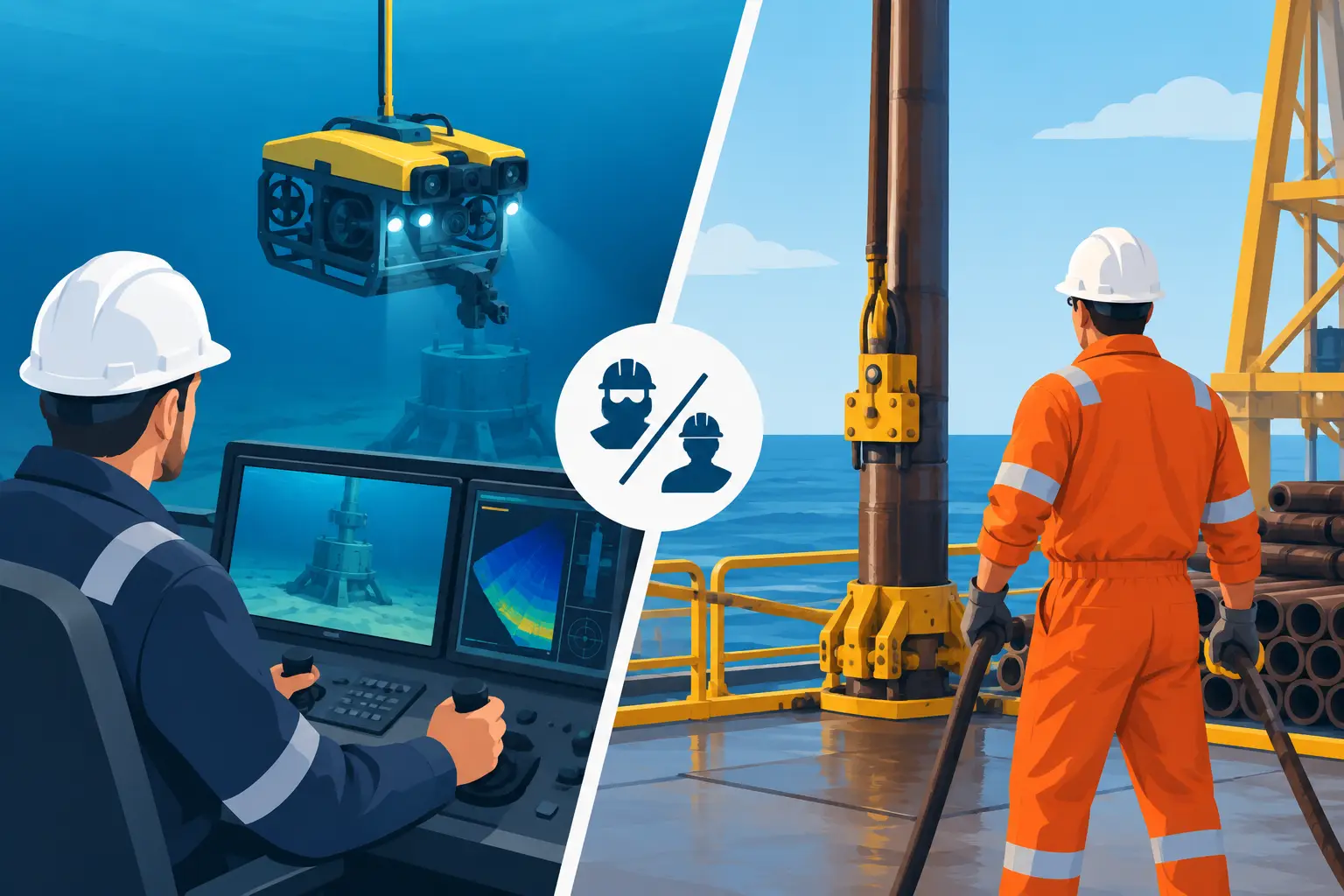
A roustabout may spend a shift handling deck equipment, supporting crane operations, and keeping work areas safe. An ROV technician may spend that same shift piloting a remotely operated vehicle thousands of feet below the surface, troubleshooting electronics, and recording subsea data. The ROV technician versus roustabout decision is not simply about which job pays more. It is about choosing the entry route that matches your current skills, timeline, and long-term offshore goal.
For candidates with no offshore experience, the roustabout role is often the more direct first step. For people with electrical, mechanical, hydraulic, electronics, or computer-based troubleshooting experience, ROV work can be a stronger technical target. Both can lead to serious earning potential and rotational work, but employers hire for them very differently.
ROV Technician Versus Roustabout: The Real Difference
A roustabout is an entry-level offshore deck and maintenance worker. The job supports the wider rig, platform, vessel, or marine construction operation. Duties can include moving materials, pressure washing, painting, basic maintenance, housekeeping, slinging loads, assisting with drilling or deck crews, and following instructions from supervisors. It is physical work, often outdoors, and safety awareness matters every minute of the shift.
An ROV technician works with remotely operated vehicles used for subsea inspection, intervention, survey, construction support, and maintenance. These systems include the vehicle itself, control cabin equipment, cameras, sonar, hydraulic systems, electrical components, winches, tether management systems, and data-recording tools. An ROV technician helps prepare, launch, operate, recover, maintain, and repair that equipment.
The biggest difference is simple: roustabout work is a broad operational entry point, while ROV work is a specialized technical discipline. A roustabout helps keep the offshore workplace moving. An ROV technician helps operate a complex subsea system where a minor fault can delay expensive vessel operations.
What the Work Feels Like Offshore
Roustabout work is hands-on, visible, and physically demanding. You may work on deck in heat, wind, rain, noise, and confined work areas. You will need to take direction well, communicate clearly, use manual handling techniques, wear PPE correctly, and stay alert around suspended loads, rotating equipment, and hazardous areas. Employers want dependable people who show up prepared, respect procedures, and do not create safety problems for the crew.
ROV work is still offshore and still demanding, but the environment is different. Some of the work happens on deck during maintenance and launch and recovery. Other parts happen in an ROV control cabin, where technicians monitor video feeds, vehicle status, sonar, tooling, and subsea tasks. Troubleshooting requires concentration. You may need to isolate whether a problem comes from power distribution, hydraulics, a camera, a sensor, a cable, software settings, or a mechanical component.
Neither role is an easy shortcut to offshore money. Roustabouts earn their place through hard physical work and consistency. ROV technicians earn theirs through technical competence, accurate reporting, equipment discipline, and calm decision-making when systems fail.
Entry Requirements Are Not the Same
A roustabout position can be one of the more accessible offshore jobs for a newcomer. That does not mean employers hire anyone who applies. You still need to present yourself as employable in a safety-critical environment. A clean, offshore-focused CV, realistic availability, required medical clearance, and the correct safety training can make a major difference.
Common useful experience includes construction, warehousing, rigging, marine work, farming, industrial cleaning, logistics, mechanical labor, and military service. The transferable value is not the job title alone. It is proof that you can work safely, follow procedures, handle physical work, and contribute to a team on long shifts.
ROV employers usually expect a more technical foundation. An electrical, mechanical, hydraulic, mechatronics, marine engineering, instrumentation, or electronics background is valuable. A trade qualification, technical diploma, military technical role, or documented experience repairing equipment can strengthen your application. Some companies do hire junior ROV personnel, but a candidate who can explain fault-finding, preventive maintenance, wiring, hydraulics, and technical documentation will stand out far more than someone with only a general interest in underwater robots.
The certifications you need depend on the country, vessel, client, and employer. Offshore survival training, medical fitness, and safety credentials are often part of the baseline. Do not spend money blindly on every course you see. Start by identifying the hiring region and target employers, then match your training plan to real job requirements.
Pay Potential and Career Progression
ROV technician versus roustabout salary comparisons can be misleading because offshore pay varies by location, rotation, contractor, experience level, vessel type, and whether travel, overtime, and allowances are included. In general, ROV technicians can have a higher long-term earning ceiling because the work is technical and specialized. The trade-off is that the entry bar is higher, and progression requires ongoing competence.
A roustabout typically starts lower on the pay scale, but the job can open the door to offshore experience, industry contacts, and progression into deck operations, crane support, drilling crews, mechanical maintenance, lifting, or other specialist pathways. A strong worker who builds certifications and takes initiative can move beyond entry-level duties.
ROV progression may move from trainee or junior technician to ROV technician, senior technician, supervisor, pilot technician, or specialist roles tied to survey, intervention, or subsea construction. The path can be financially rewarding, but it requires you to keep learning. Technology, client standards, and equipment packages change from project to project.
Which Role Should You Target First?
Choose roustabout roles first if you need an accessible way into offshore work, are comfortable with physical labor, and want to build offshore credibility. This route is especially practical for candidates coming from construction, laboring, warehousing, maritime deck work, or industrial services.
Target ROV roles if you already have technical evidence on your CV. That could mean electrical installation, diesel mechanics, hydraulic repair, electronics, instrumentation, IT hardware, marine engineering, or maintenance work. If your experience is technical but not directly offshore, your application must translate those skills into the language ROV employers use: diagnostics, planned maintenance, fault-finding, drawings, systems testing, reporting, and safety compliance.
Use four questions to make the decision:
- Do you want to enter offshore as quickly as possible, or are you prepared to build technical qualifications first?
- Does your work history prove physical operational reliability, technical troubleshooting ability, or both?
- Do you prefer outdoor deck work and varied manual tasks, or detailed work with equipment and control systems?
- Are you pursuing an immediate offshore foothold or a specialized long-term technical career?
There is no wrong answer. The mistake is applying for ROV jobs with a generic laborer CV, or applying for roustabout jobs while failing to show that you understand offshore safety and physical expectations.
How to Make Your Application Competitive
For roustabout applications, lead with safety, reliability, physical capability, and relevant practical experience. Name equipment you have used, site procedures you have followed, lifting or rigging exposure you have, and the environments where you worked long shifts. Keep the CV clear and factual. Offshore recruiters often scan quickly for evidence that you can arrive ready to work.
For ROV applications, lead with your systems knowledge. Include technical qualifications, maintenance experience, fault-finding examples, electrical or hydraulic exposure, tools used, and any experience reading schematics or completing inspection records. Avoid claiming ROV skills you do not have. Instead, show why your existing technical background makes you trainable.
Your job search should also be targeted. Offshore hiring is fragmented across drilling contractors, vessel operators, ROV service companies, subsea contractors, crewing agencies, and energy service firms. A structured search process prevents you from sending the same weak application to dozens of companies. RouteK helps candidates organize that process around the right certifications, employer targets, CV quality, and application strategy.
A roustabout job can be the move that gets you offshore this year. An ROV technician path can be the move that builds a specialist career over the next decade. Pick the route that fits your evidence today, then build the next set of skills with a clear reason behind every application.
Leave a Reply