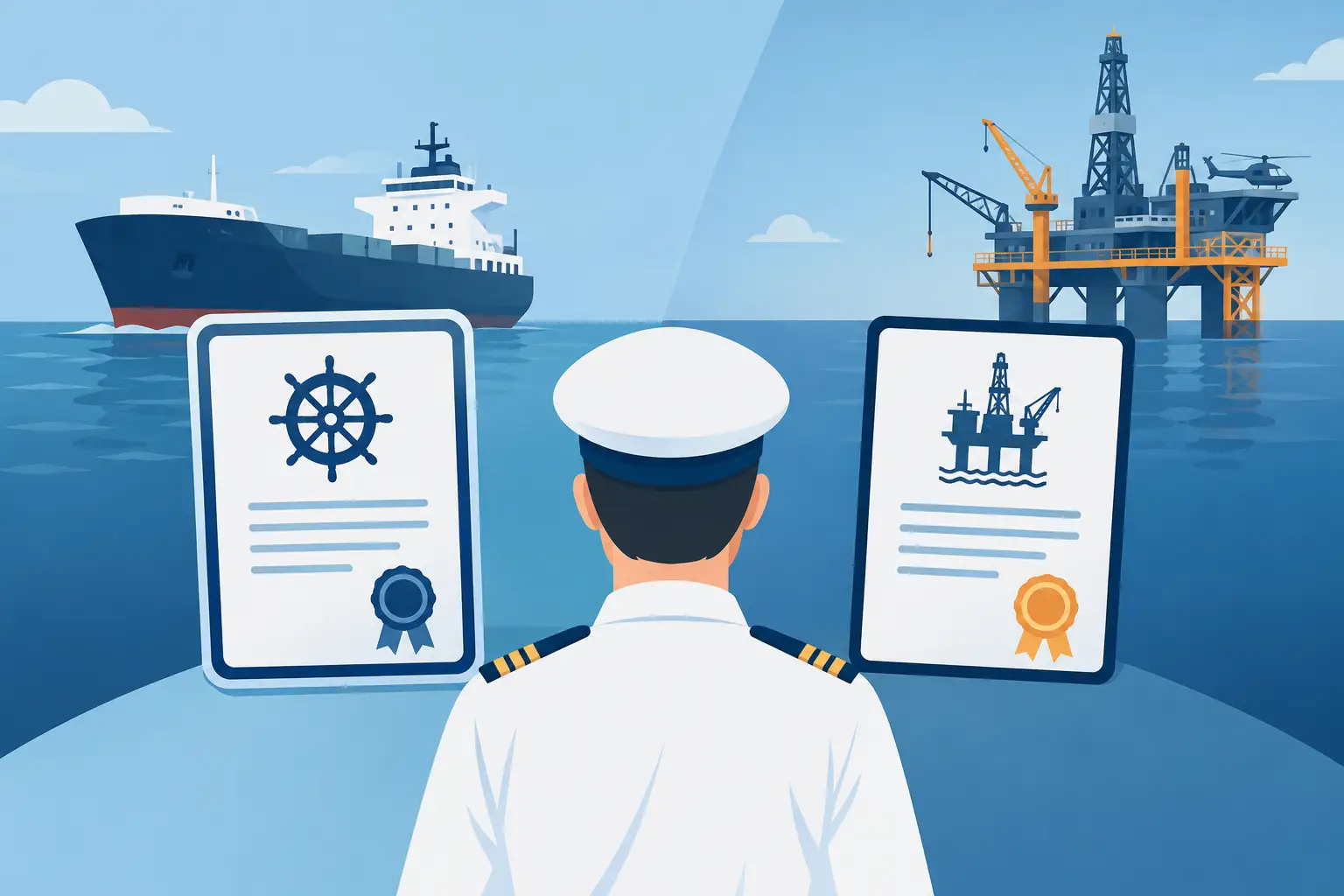
A recruiter can reject an otherwise strong offshore candidate before reading the second line of their CV because the required training is missing. That is why understanding STCW versus offshore certificates matters before you spend money on a course. These credentials are not interchangeable, and choosing the wrong one can leave you qualified for work you are not actually applying for.
For people entering offshore work, the goal is not to collect every certificate available. The goal is to identify the job, location, transport method, and employer standard first, then build the training profile that gets your application through screening.
What STCW Certification Actually Means
STCW stands for Standards of Training, Certification and Watchkeeping for Seafarers. It is an international framework that sets minimum training and competency standards for people working on commercial vessels. The convention is administered through national maritime authorities, so the certificate format, approval process, and additional requirements can vary by country.
The key point is this: STCW is maritime training. It is most relevant when your work is on a vessel, particularly one that operates internationally or is subject to flag-state maritime rules. A supply vessel, cargo ship, tug, cruise ship, research vessel, or certain offshore support vessel may require STCW credentials for crew members.
Entry-level STCW Basic Training commonly covers four core areas: personal survival techniques, fire prevention and firefighting, elementary first aid, and personal safety and social responsibilities. It teaches you how to respond to emergencies at sea, work safely around vessel operations, and understand the responsibilities expected of professional seafarers.
That training can be valuable, but it does not automatically qualify you for every job connected to the offshore industry. STCW is not a universal offshore pass. It is one part of a hiring profile for specific maritime roles.
When STCW is likely to matter
STCW is often relevant if you want to work as vessel crew, deck crew, engine-room personnel, stewards, cooks, or other personnel assigned to a ship. It may also matter for offshore support roles when the employer hires workers under vessel crewing rules.
In the United States, the role may also involve credentials issued or recognized by the U.S. Coast Guard, such as a Merchant Mariner Credential. The exact requirement depends on the vessel, its flag, your duties, and where it operates. Do not assume that completing a basic STCW course alone makes you eligible to sail in every position.
STCW Versus Offshore Certificates: The Practical Difference
Offshore certificates are a broader category. They are designed for people who work on oil and gas installations, offshore wind sites, drilling rigs, production platforms, construction projects, or vessels supporting those operations. Their purpose is usually to prepare you for the risks of getting to, working at, and evacuating from an offshore installation.
Unlike STCW, offshore training is often driven by an industry body, operator requirement, client policy, regional regulation, or transport arrangement. The certificate an employer expects can change dramatically between the Gulf of Mexico, the North Sea, Brazil, the Middle East, Southeast Asia, and offshore wind projects along the U.S. coast.
For example, an offshore oil and gas employer may ask for BOSIET training, which is commonly associated with helicopter travel and emergency response in offshore energy. Depending on the course standard and region, this can include helicopter underwater escape training, sea survival, emergency breathing systems, firefighting, and offshore safety procedures.
A North Sea operator may require BOSIET or a refresher such as FOET, plus a current offshore medical. A Gulf of Mexico employer may focus on helicopter underwater escape training, water survival, company-specific safety orientation, drug screening, and role-specific competence. An offshore wind contractor may prioritize GWO Basic Safety Training, including working at heights, manual handling, fire awareness, first aid, and sea survival.
Same broad industry. Different entry requirements.
Match the Certificate to the Worksite, Not the Job Title
Job titles can be misleading. A roustabout, rigger, mechanic, welder, cook, or electrician may work on a platform, a drillship, a supply vessel, or an offshore wind installation. The title might stay similar, but the certification path changes with the worksite.
Before booking training, answer four questions:
- Will you be assigned to a vessel or an offshore installation?
- How will you travel to work: helicopter, crew boat, or another method?
- Which country or operating region is the job in?
- What does the actual job posting or employer onboarding list as required?
This is where many new candidates waste money. They hear that an acquaintance needed BOSIET, take BOSIET, then apply for U.S.-based vessel work that needs maritime documentation instead. Or they take STCW Basic Training and expect it to satisfy a wind technician role that requires GWO training.
Training should follow the target job market. It should not be based on a generic online claim that one certificate is “the offshore certificate.”
What Entry-Level Candidates Should Prioritize
If you have no offshore experience, start by choosing a lane. You do not need your entire career mapped out, but you do need enough focus to avoid random training purchases.
For maritime vessel work, research STCW Basic Training, the required medical fitness process, and any credentials needed for the position you want. If you are pursuing U.S. vessel jobs, learn whether a Merchant Mariner Credential and Transportation Worker Identification Credential are part of the hiring path. Requirements depend on the role, so verify them with the employer or approved training provider before enrolling.
For offshore oil and gas, look at the regions and companies you plan to target. BOSIET may be requested for international or helicopter-based assignments, while a domestic employer may have a different route. For drilling, production, and maintenance roles, employers also care about practical experience, safety attitude, physical readiness, and whether your CV clearly shows transferable skills.
For offshore wind, focus on the training standard named in job advertisements. GWO is common across the sector, but individual employers may require additional rope access, electrical, rescue, or technical credentials. A construction background, industrial electrical experience, mechanical maintenance, or wind experience can all strengthen your position when paired with the right safety training.
Certifications Get Attention, But They Do Not Get Hired Alone
A certificate proves you completed training. It does not prove you can work a 12-hour shift in difficult weather, follow a permit system, communicate during a safety-critical task, or contribute to a crew on day one. Employers hire the full picture.
Your CV should connect your prior experience to offshore value. Construction workers can show hazard awareness, tools, lifting operations, and work at heights. Mechanics can show preventive maintenance, troubleshooting, and equipment reliability. Logistics workers can show inventory control, material handling, and coordination. Military, maritime, manufacturing, and industrial candidates often have strong evidence of discipline and procedural work.
Do not bury that experience beneath a long certificate list. Put your relevant skills, safety record, equipment knowledge, work authorization, location flexibility, and availability where a recruiter can find them quickly. Then list current certificates accurately, including expiration dates where relevant.
There is also a timing trade-off. Some offshore credentials expire or require refresher training. Taking a course too early can mean paying again before you land a role. On the other hand, waiting until after you apply can slow you down if employers require proof before they will consider you. The smart move is to identify the few credentials that repeatedly appear in your target job postings and build from there.
A Better Way to Plan Your Training Budget
Treat certifications as an employment investment, not a shopping list. Review a sample of real postings from the companies, vessel operators, drilling contractors, and service providers you want to join. Write down the requirements that appear repeatedly. Separate them into three groups: required before applying, preferred but not essential, and provided after hire.
Then confirm the training provider is accepted in the region where you plan to work. A legitimate course that is not recognized by your target employer still may not help your application. Ask direct questions about approval, course validity, practical assessments, refresher periods, and whether the certificate is accepted by named operators.
This approach is especially useful for career changers. You may not need to spend thousands of dollars to become employable for your first offshore role. You need a targeted plan, a strong application, and a clear understanding of what employers expect from newcomers.
STCW and offshore certificates can both open doors, but only when they match the door you are trying to walk through. Pick your target market first, verify the employer standard, and build a training path that supports a real application strategy. That is how you move from researching offshore jobs to being ready for them. Is it true that working as a commercial fisherman can destroy your body in just a few years? These workers spend hours hauling heavy fishing gear, handling enormous catches, and fighting against waves on decks that never stop moving. But the most frightening part isn’t always the weather. It’s what the job can do to your body over time. Repeatedly lifting heavy loads can damage your back and joints, while working around powerful winches and cables creates the risk of life-changing injuries. And below deck, the constant roar of engines can permanently damage your hearing if you’re exposed to dangerous noise without proper protection. Some fishing crews also work extremely long shifts, and exhaustion can slow their reactions at exactly the moment they need to be alert. Imagine trying to control heavy equipment on a slippery deck while the vessel rolls beneath your feet.
Leave a Reply