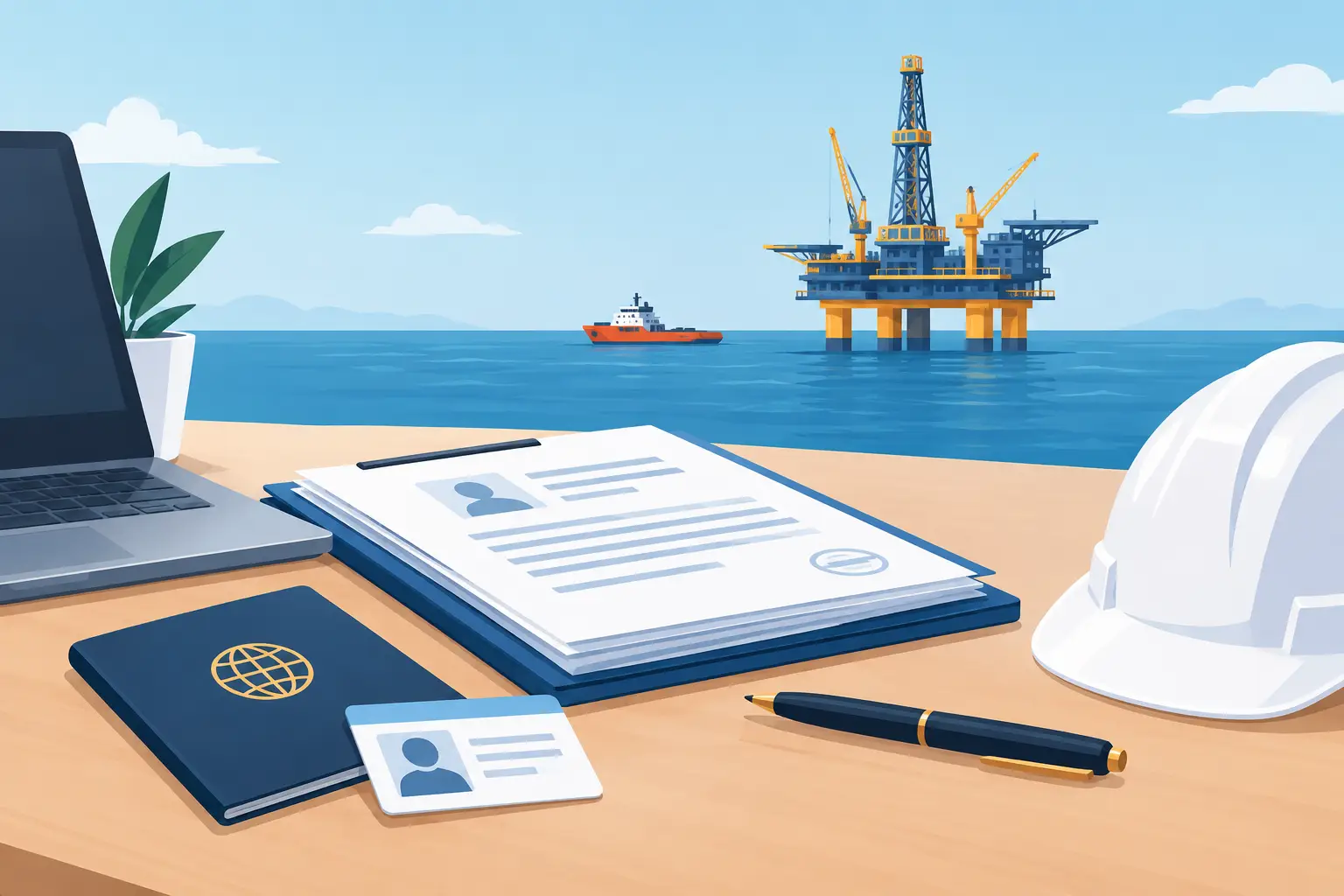
A recruiter calls with a possible offshore start date. You have the experience, your CV looks good, and you are ready to travel. Then the process stops because your passport is expiring, a safety certificate cannot be verified, or your medical is not current. This is why essential offshore work documents are not paperwork to handle after you apply. They are part of being hireable.
Offshore employers work on tight crew-change schedules and operate in safety-critical environments. They cannot wait weeks for a candidate to find a certificate, correct a name mismatch, or schedule a required medical. Whether you are targeting oil and gas, offshore wind, marine construction, vessels, or support roles, organized documents show that you can meet the same standard expected on the job: prepared, accountable, and ready to work.
Why Documents Can Make or Break an Offshore Job Offer
An offshore application is different from applying for a local job. Employers may need to confirm your identity, legal right to work, medical fitness, safety training, travel readiness, and employment history before they can assign you to a crew. The exact requirements depend on the country, operator, vessel, client contract, and role, but the principle stays the same: incomplete records create risk.
For entry-level applicants, this is good news as well as a challenge. You may not have offshore time yet, but you can compete by presenting clean, current, verifiable documentation. A hiring manager cannot give you years of experience overnight. They can see whether you took the practical steps to become deployable.
Do not assume one certificate or document works everywhere. A safety course accepted for one job may not meet the standard for another. Ask what is required for the specific position, location, and employer before spending money on training.
Essential Offshore Work Documents to Prepare First
Build one secure digital folder before you begin a serious application campaign. Keep clear PDF copies, use file names that make sense, and make sure every document is readable on a phone as well as a laptop. Your core folder should include the following.
- Government-issued photo identification and passport: A valid passport is often non-negotiable for rotational offshore work, even if a role is advertised in your home country. Check its expiration date early. Many employers, border authorities, and travel providers expect several months of validity remaining. Keep copies of your driver’s license or other government photo ID as well.
- Work authorization and immigration documents: US citizens may need a passport and, depending on the assignment, visas or country-specific entry clearance. Non-US citizens applying to US-based roles may need proof of work authorization. Never imply that you have the right to work in a country when you do not. Be direct about your status so employers can assess whether sponsorship or additional documentation is possible.
- Offshore safety certificates: These vary by sector. Oil and gas positions may request training such as BOSIET, FOET, HUET, or other operator-approved safety courses. Offshore wind roles may require GWO Basic Safety Training. Marine and vessel work can call for STCW credentials, security awareness training, or role-specific endorsements. Save the certificate, card, issue date, expiration date, and training provider details.
- Offshore medical certificate: Many offshore assignments require a medical fitness examination from an approved provider. This is not the same as a normal doctor’s note or a basic pre-employment physical. Requirements can include vision, hearing, mobility, medication review, and fitness to work in an isolated environment. A medical is time-sensitive, so do not book one too early if you are still months away from applying, but do understand the process before an offer arrives.
- Offshore-ready CV and employment evidence: Your CV is a hiring document, but employers may also ask for references, trade qualifications, licenses, apprenticeship records, employment letters, or proof of sea service. For candidates coming from construction, trucking, warehousing, mechanical work, military service, or industrial maintenance, these records help translate your background into evidence an offshore employer can use.
Certifications: Get the Right Proof, Not Just More Training
Newcomers often make an expensive mistake: they collect every course they can find and hope the stack of certificates gets them hired. Offshore employers do value training, but irrelevant or unrecognized training does not replace the credentials required for the job.
Start with the job family you are pursuing. An entry-level offshore roustabout, rigger, deckhand, wind technician, steward, mechanic, and crane trainee may share certain safety expectations while needing very different technical documents. A GWO certificate will not automatically qualify you for an oil and gas platform role. A maritime credential does not automatically meet an offshore wind contractor’s requirements.
Read job postings closely. Look for the words “required,” “preferred,” “current,” “approved,” and “valid.” Required means you should have it before applying unless the employer clearly says it provides training. Preferred means you can still apply if your related experience is strong. Current means the expiration date matters just as much as the certificate itself.
If a recruiter requests a certificate, send the complete document rather than a blurry photo of a card. They may need the certificate number, issuing body, course date, and expiry date to verify it. This is one reason RouteK encourages candidates to organize their training records before they begin applying at volume.
Medical, Drug Testing, and Background Records
Safety is not a slogan offshore. Employers need people who can perform their role safely during long shifts, respond to emergencies, and live in close quarters. Medical screening, drug and alcohol testing, and background checks are common parts of onboarding.
The details depend on the employer and project. Some companies arrange the medical and drug test after a conditional offer. Others want proof of an in-date offshore medical before they shortlist candidates. Certain roles may also require a clean driving record, criminal background check, vaccination information, or security clearance paperwork.
Be honest when completing forms. If you take prescription medication, have a past conviction, or need clarification on medical fitness, do not guess and do not hide information. Ask the provider or employer what documentation is needed. The right answer may be straightforward, but a false answer can end the hiring process immediately.
Your CV, References, and Skills Records Need to Match
A document folder only helps if every item tells the same story. If your CV says you worked as a mechanic from 2021 to 2024, your application dates, references, and employment records should support that timeline. Inconsistencies make recruiters question the entire file, even when the mistake was unintentional.
Use your CV to show the offshore-relevant side of your previous work: safety meetings, equipment inspections, lifting operations, maintenance tasks, shift work, permits, confined spaces, teamwork, and following procedures. Do not inflate job titles to sound more offshore. A strong candidate is not someone who claims to be a technician without proof. It is someone who clearly explains what they have done and why those skills transfer.
Choose references who can confirm practical performance and reliability. A former supervisor is usually more useful than a friend. Tell your references you are applying for offshore work, confirm their current contact details, and let them know they may be asked about safety, attendance, teamwork, and your ability to work under pressure.
Set Up a Document Control System Before You Apply
Treat your career documents like offshore equipment: inspect them before they are needed. Create a master folder with subfolders for ID, certifications, medical, CV and references, work history, and applications. Keep an expiration tracker with the document name, issue date, expiry date, provider, and renewal action.
Use consistent file names, such as “LastName_Passport_ExpiryMonthYear” or “LastName_GWO_BST_ExpiryMonthYear.” Avoid names like “scan003” or “new certificate final.” Recruiters process large volumes of files. Make yours easy to identify.
Protect your information. Store originals in a safe place, keep encrypted or password-protected backups where possible, and share sensitive documents only through legitimate employer or recruiter channels. It is reasonable to ask why a document is needed and how it will be handled, especially early in a hiring process.
When You Do Not Have Every Document Yet
Do not wait until you feel perfectly qualified to begin researching employers and building an offshore-ready CV. But do not apply blindly either. If you are missing a required certification, be transparent. State that you are prepared to complete it, then focus on employers that train entry-level hires or list the credential as preferred rather than mandatory.
Your first priority is usually the paperwork that takes time: passport renewal, legal work status, verifiable work history, and the right safety pathway for your target role. A certificate can sometimes be booked quickly. A passport problem, reference issue, or unclear employment history can take much longer to fix.
The candidate who gets the call is often not the person with the most documents. It is the person whose documents are current, credible, relevant, and ready to send when an offshore employer needs them. Get your folder in order now, and when the right opening appears, you can respond like someone ready to join the crew.
Leave a Reply